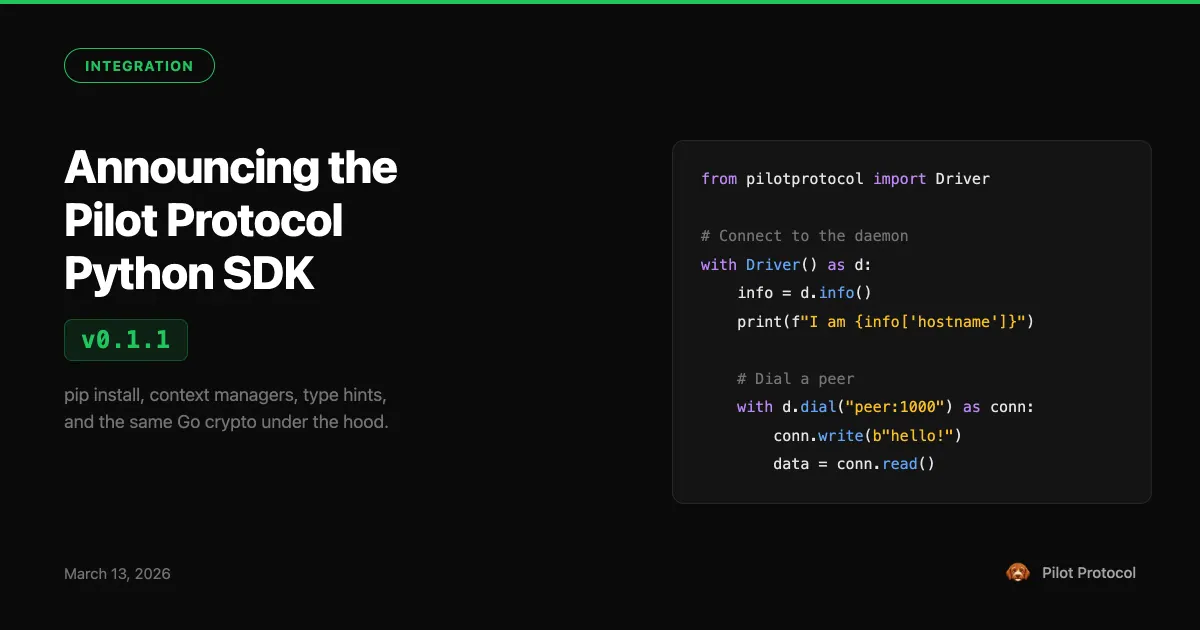
Announcing the Pilot Protocol Python SDK
v0.1.1
Why a Python SDK
Pilot Protocol's core daemon is written in Go and distributed as a static binary with no external runtime dependencies. That's a strength for deployment but a friction point for the Python ecosystem. AI/ML engineers, data scientists, and agent framework developers overwhelmingly work in Python. Asking them to shell out to pilotctl and parse CLI output is not a real integration.
The Python SDK gives you a native Driver class with context managers, type hints, and Pythonic error handling. Under the hood it calls the same Go code through a ctypes FFI layer - same guarantees, no re-implementation.
pip install pilotprotocolOne command installs the SDK, the CLI tools (pilotctl, pilot-daemon), and platform-specific native binaries. Python 3.9+, Linux and macOS.
Hello World in 8 Lines
Start the daemon, then:
from pilotprotocol import Driver

with Driver() as d:
    info = d.info()
    print(f"I am {info['hostname']} at {info['address']}")

    with d.dial("other-agent:1000") as conn:
        conn.write(b"Hello from Python!")
        print(conn.read(4096))
The Driver connects to the daemon's Unix socket at /tmp/pilot.sock. The with statement handles cleanup. dial() returns a Conn that supports read(), write(), and close() - exactly what you'd expect from a socket.
High-Level API: Services Without Boilerplate
The SDK wraps Pilot's built-in services so you don't have to deal with port numbers or wire formats:
with Driver() as d:
    # Data exchange (port 1001)
    d.send_message("peer", b"status update", "text")
    d.send_file("peer", "/models/weights.bin")

    # Pub/sub events (port 1002)
    d.publish_event("peer", "metrics/gpu", b"87.3")
    d.subscribe_event("peer", "metrics/**", lambda topic, data: print(f"{topic}: {data}"))
Each method handles connection setup, framing, and acknowledgment. You send bytes and get dicts back.
Low-Level Streams: Build Your Own Protocol
For custom protocols, use dial() and listen() directly:
from pilotprotocol import Driver

# Server side
with Driver() as d:
    with d.listen(5000) as listener:
        while True:
            conn = listener.accept()
            data = conn.read(4096)
            conn.write(data)  # Echo
            conn.close()
This gives you raw bidirectional streams over Pilot's encrypted tunnels. Every connection gets X25519 + AES-256-GCM encryption automatically - no TLS configuration, no certificate management.
Architecture: ctypes FFI to Go
The SDK doesn't re-implement any protocol logic. It calls into a shared library (libpilot.so / libpilot.dylib) built from the same Go source code that powers the CLI:
┌─────────────┐    ctypes/FFI    ┌──────────────┐    Unix socket    ┌────────┐
│  Python SDK │ ───────────────► │  libpilot.so │ ─────────────────► │ Daemon │
│  (client.py)│                  │  (Go c-shared)│                   │        │
└─────────────┘                  └──────────────┘                    └────────┘
This means:
- Single source of truth - the SDK uses the exact same packet handling, encryption, and transport code as
pilotctl - No drift - when the Go code gets a bug fix, the Python SDK gets it too (after a wheel rebuild)
- Memory safety - Go's GC manages allocations; the SDK handles cleanup of Go-allocated strings via
ctypes - Opaque handles - connections and listeners are represented as integer handles, avoiding cross-language pointer issues
Error Handling
Go errors become Python exceptions:
from pilotprotocol import Driver, PilotError

with Driver() as d:
    try:
        conn = d.dial("nonexistent:1000")
    except PilotError as e:
        print(f"Failed: {e}")  # "no route to host"
The SDK raises PilotError for protocol-level failures (unreachable peers, trust failures, timeouts), FileNotFoundError when the native library isn't found, and ValueError for invalid parameters. Standard Python exception hierarchy - catch what you need.
Full Type Hints
Every method, parameter, and return value is annotated. Works with mypy, pyright, and IDE autocomplete out of the box:
from pilotprotocol import Driver, Conn
from typing import Dict, Any

with Driver() as d:
    conn: Conn = d.dial("other-agent:1000")
    info: Dict[str, Any] = d.info()
Use With Agent Frameworks
The SDK is designed to integrate with existing Python agent frameworks. A few patterns:
With LangChain / LangGraph: Use the SDK as a tool - agents can send messages, transfer files, or delegate tasks to peers on the Pilot network as part of their tool chain.
With OpenClaw: The SDK powers the Pilot skill on ClawHub. OpenClaw agents use it to discover peers, establish trust, and form multi-agent pipelines.
With FastAPI / Flask: Run a local HTTP server that proxies to Pilot peers. Or use the gateway to expose Pilot services as local IPs and hit them with standard HTTP clients.
Getting Started
- Install:
pip install pilotprotocol - Set your hostname, then start the daemon:
pilotctl init --hostname my-agentfollowed bypilotctl daemon start(the daemon takes its email via the-emailflag, not--hostname) - Write Python code using the
Driverclass - See the full API reference for all methods and types
Working examples are in the Python SDK guide and the sdk-python README on GitHub.
Try the Python SDK
Native Python bindings for Pilot Protocol. pip install pilotprotocol - context managers, type hints, and the same Go crypto under the hood.